Runs on your machine · No per-task bill · Business and personal
ARIA AUTOMATIONS · for the business you run and the life around it

Every workflow tool hands you boxes to wire. ARIA hands you an operator.

A tool you wire.An operator you own.

The leads coming into your shop. The inbox you can't keep up with. The price you're waiting on, the page you keep checking, the week you want to look back on. Say it in a sentence. ARIA builds the flow, step by step, with a route for every failure, and rehearses it without touching anything real. Then she runs it on your machine, and steps in with her own mind only where a step needs judgment. What's yours to decide waits for you in one place.

✓ Business and personal·✓ Her mind inside it·✓ Every run on a sealed record
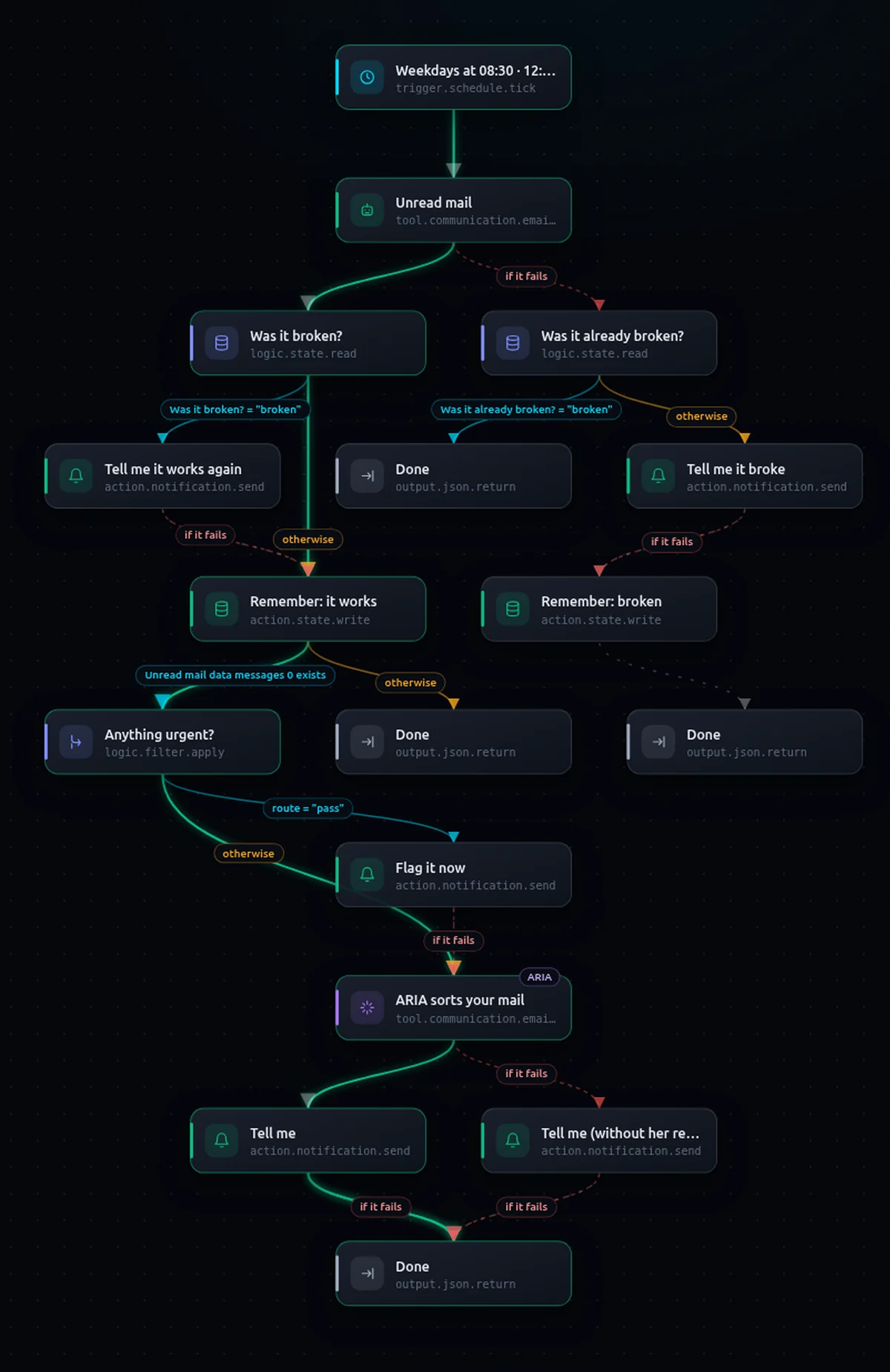
Inbox triage, live on ARIA's canvas: the path its last run took glows step by step, from the unread mail to ARIA sorting it and telling you
Real flows from ARIA's canvas

Your business. Your life. Say it once.

Your shop, your inbox, your competitors. Your money, your mornings, the page you keep refreshing, the server at home. Tell ARIA what should run on its own, and she builds the flow and runs it. Pick a sentence and see the flow.

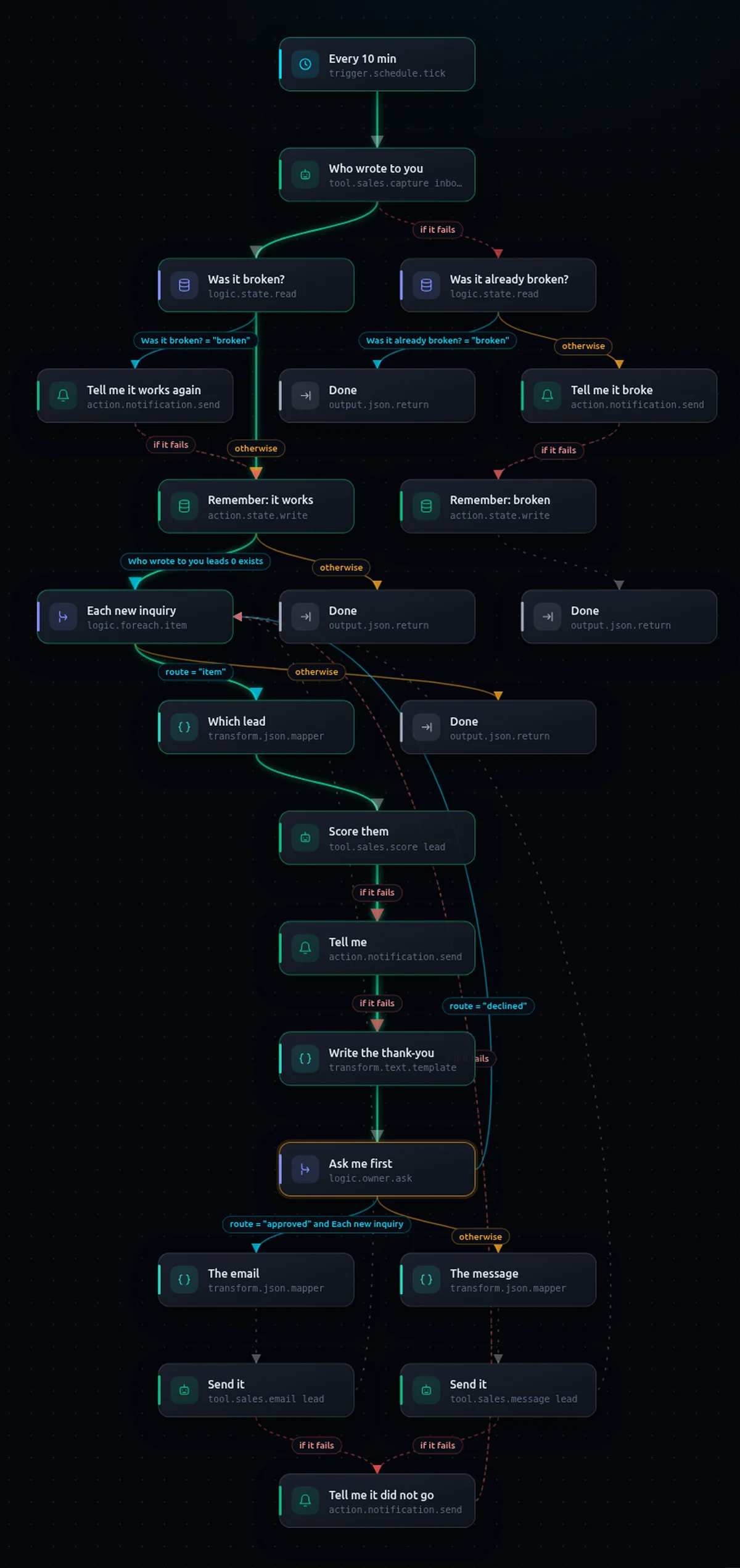
Speed-to-lead, a real flow on ARIA's canvas: 23 steps
Speed-to-leadAsks you first23 steps · every failure routed

Inbox, Instagram, Messenger and texts read. Each new inquiry scored into Sales, you told at once, the thank-you written and held at Ask me first.

Ask in your own words, or start from these. Every flow shows the path its last run took, and every place it could fail already has somewhere to go.

You don't have a software problem. You have a glue problem.

Your business runs on apps. The apps run on you.

The inbox, the shop, the bank, the calendar, the invoices. Each one is clever alone and blind to the rest, so the thing holding them together is you: copying, checking, chasing. The workflow tools that promised to fix it handed you a second job instead. Diagrams to wire. Fields to map. A code box for whatever the boxes can't say. And a meter that ticks every time your business does something.

Leads
42 h
is how long the average company took to answer a web inquiry. 23% never answered at all. The customer had already moved on.
Harvard Business Review, 2011
2,241 US companies audited
Code
31%
of the 200 most-viewed n8n workflow templates contain a hand-written code step. The no-code tool still needs code.
Our count · n8n public templates
October 2026, api.n8n.io
Failure
89%
of those same templates have no error branch. When a step breaks, nothing routes around it, and nobody built the part that would tell you.
Our count · the same 200 templates
Failure handling is left to you
Billing
$/task
is how cloud automation is billed: by the task, by the operation. The busier you get, the bigger the bill, for the same work, on servers that hold your keys.
Structural · per-task pricing
Your growth is their meter

"An automation you have to babysit is a second job."

— The trade ARIA refuses
"Just connect it with a zap." "Map field 14 to field 9." "Paste this into the code node." "Don't worry, the test run is safe." (It sent the real email.)
Wired. Billed. Babysat. That is automation as a rented service. An operator with a mind is what ends it.
Not a workflow tool. An operator.

What changes when the automation has a mind.

A workflow tool waits for you to wire it, breaks quietly, and phones a bare model when it's stuck. ARIA builds the operation, runs it, connects whatever it needs, and thinks inside it when thinking is what the step needs. Four things no box-and-arrow tool can do.

01 · Words, not wiring

You say it. She builds it.

One sentence in the chat. ARIA drafts the whole flow: what starts it, every step, every branch, and a route for every failure. She checks it and rehearses it on sample data with every side effect simulated. Change any step by asking her in words.

No field mapping. No code box.
02 · Judgment is a step

Her mind, inside the flow.

Plain work runs with no AI call at all: fetch, read, compare, remember, notify. Where a step needs judgment, ARIA herself runs it, with her memory, her tools and her agents. She reads and judges, and when an act she chooses needs your OK, the run waits for it. Every run shows exactly what it spent.

Plain work runs free. Judgment is a step you can see.
03 · Any service

She forges the connection herself.

A service she doesn't know yet? She reads its own description, its API spec, its MCP server, its WSDL, and builds the connection as sealed data, not code. You ratify its card. Your key goes into the vault, and she never sees it.

No waiting for an integration. Forged, then ratified.
04 · Your switch

Switching on is the contract.

Before anything runs while nobody watches, you see every tool it may use and which ones use her mind. Money moves only under a cap you set, or with your yes naming the amount. Legal acts ask every time. Revoke any of it in a tap.

Granted exactly. Revoked instantly.
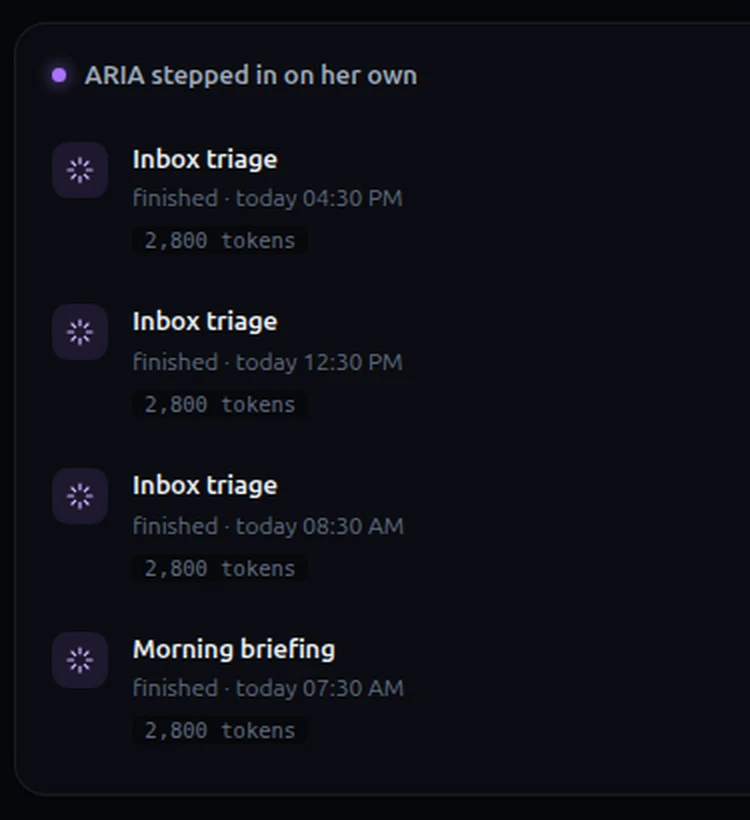
Needs you, ARIA stepped in on her own: Inbox triage three times and the morning briefing, each finished, each with the 2,800 tokens her mind spent
What no workflow tool has
The operator thinks

Her mind is a step.

Other tools bolt a model onto a box: a bare prompt, no memory, no hands. In ARIA, the judgment step is ARIA herself: her whole mind, with what she remembers about you, her tools and her agents, running inside the flow with a focused instruction. She reads and judges. If her mind decides something needs you, the run parks in Needs you with her own words, and your yes answers that one step. Every run records what her mind spent, to the token.

Formulas, no code boxLearned web skills, zero tokensLive event streamsState between runsFan-out to child runsHer agents' own tools
Free until it isn't

Most steps never call a model: fetch, read, compare, remember, template, notify. In the day below, 94.4% of runs made no AI call. Her mind runs only where the flow puts it.

Her automations become her hands

Give one a name and it becomes a tool she holds while it's live. Ask her something in chat, and she can run the operation you built together, the same way she uses any tool.

Operations that compose

An automation can call another and use its answer, three deep, never in a loop. Each one remembers between runs, so "only the new ones" and "only on a change" are one step, not a database you maintain.

One Tuesday at a design studio

71 runs. Two decisions.

Six automations on, the owner away from the desk. Her clock fired 69 of the 71 runs. This is everything that reached the owner, and when.

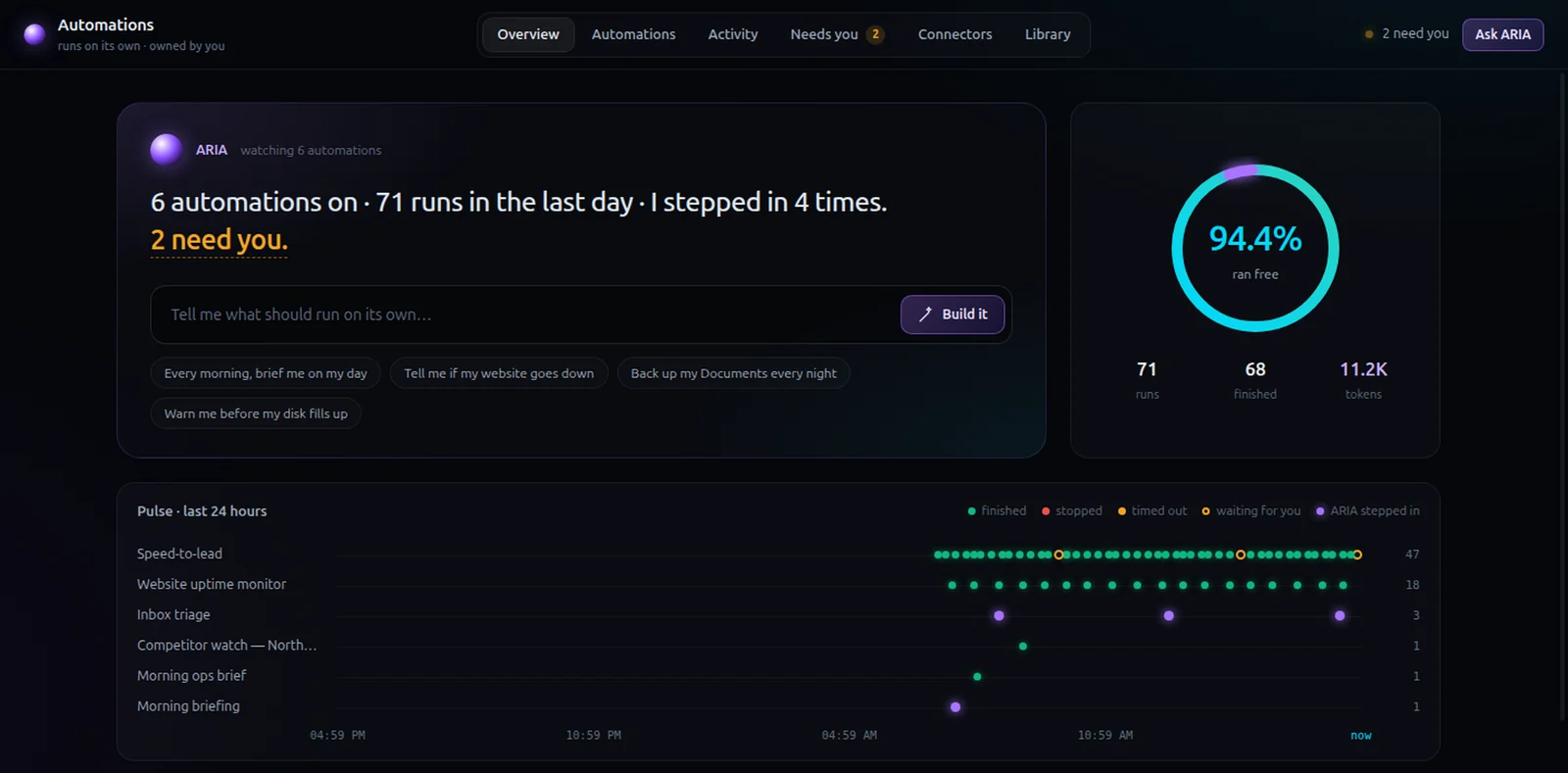
ARIA's Automations overview at the end of the day: six automations on, 71 runs, she stepped in 4 times, 2 need you, and a ring showing 94.4% ran free
  1. 07:30
    Morning briefingARIA stepped in

    Two things today: the brand review with Bistro Verde at 10:00, and the call with James at 14:30. The afternoon after that is yours.

  2. 08:00
    Morning ops briefFree · no AI

    Move first: invoice #1042 for Bistro Verde is 12 days overdue. Send the friendly reminder today.

  3. 08:30
    Inbox triageARIA stepped in

    14 unread. Needs an answer today: Tom Berger signed the contract and wants to start next week.

  4. 09:05
    Competitor watchYou

    You switched it on. Northwind Studio's offer page is now watched for free. You hear only when it changes.

  5. 09:55
    Speed-to-leadWaits for you

    Lena Fischer on Messenger: "Can you do the same menus for our bakery?" Now a lead in Sales, scored 91. The thank-you is written and waits for your yes.

  6. 10:05
    YouYou

    One tap: Approve. The thank-you goes out on Messenger and lands on Lena's timeline in Sales.

  7. all day
    Website uptime monitorFree · no AI

    Looked every 30 minutes. Never once had a reason to speak.

  8. 14:10
    Speed-to-leadWaits for you

    Maria Costa on Instagram: a second restaurant opening in March. Scored 88. The thank-you waits.

  9. 16:55
    Speed-to-leadWaits for you

    James Okafor by email: pricing for a five-page website. Scored 74. The thank-you waits.

  10. 17:05
    You open ARIAYou

    "2 things only you can decide. Everything else, ARIA handled."

71runs
68finished
94.4%made no AI call
4times ARIA stepped in
2decisions left for you

The studio, its customers and their messages are an example business. The engine, the runs and the screens are ARIA's.

The Automations view

Six screens. One operator.

Build, decide, grant, prove, start, watch. ARIA's own Automations view, as she ran the day above.

Build

Business and personal, in one rail.

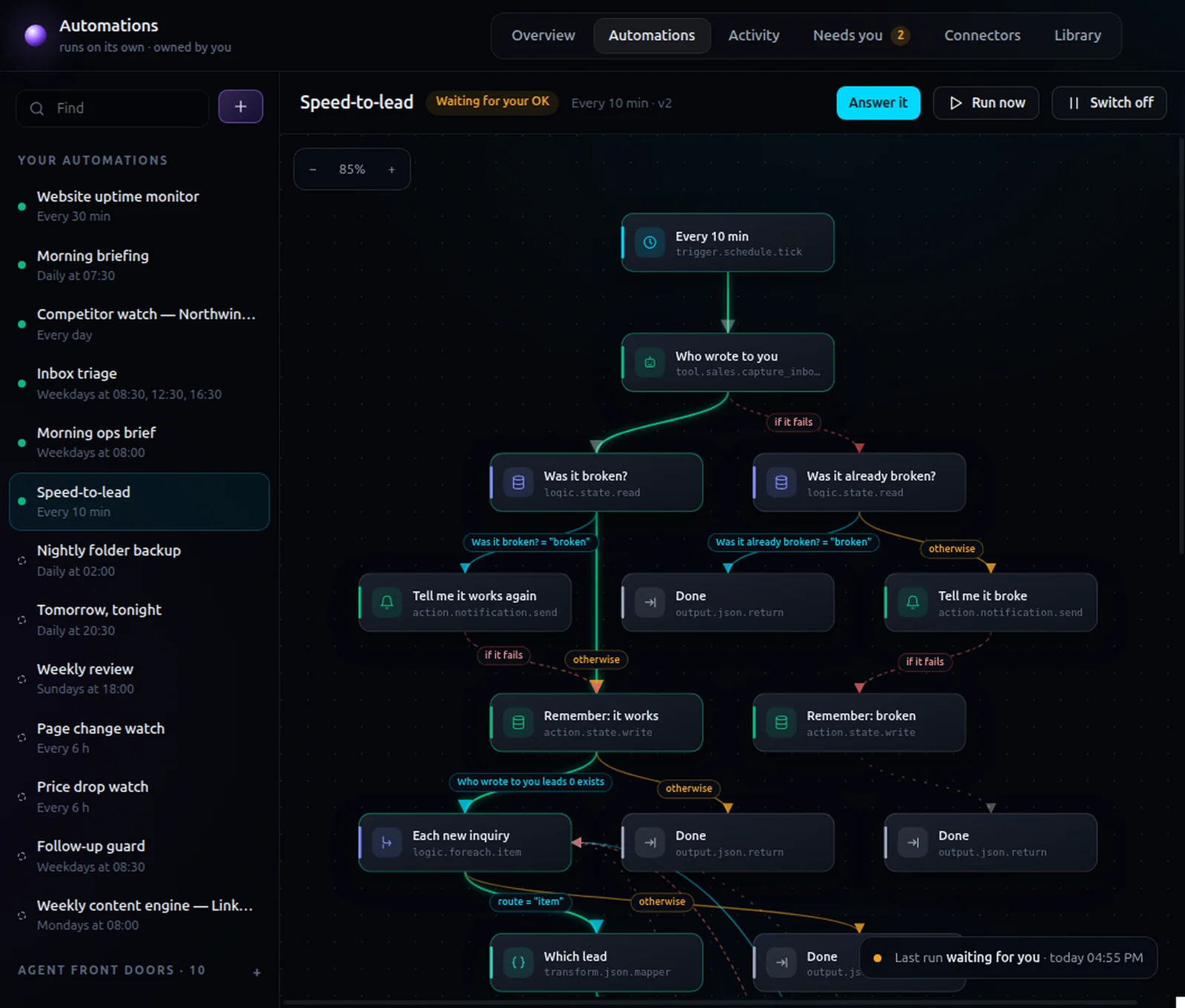
Speed-to-lead sits beside the weekly review, the price watch beside the morning ops brief. Open any one and every step is on the canvas: the path its last run took glows, the gold step is the one waiting for you, and every "if it fails" route was hers, not yours. Click a step to see what it does, or ask her to change it in words.

ARIA's Automations view: business and personal automations in one rail, and Speed-to-lead open on the canvas, waiting for your OK
Decide

One inbox for everything only you can decide.

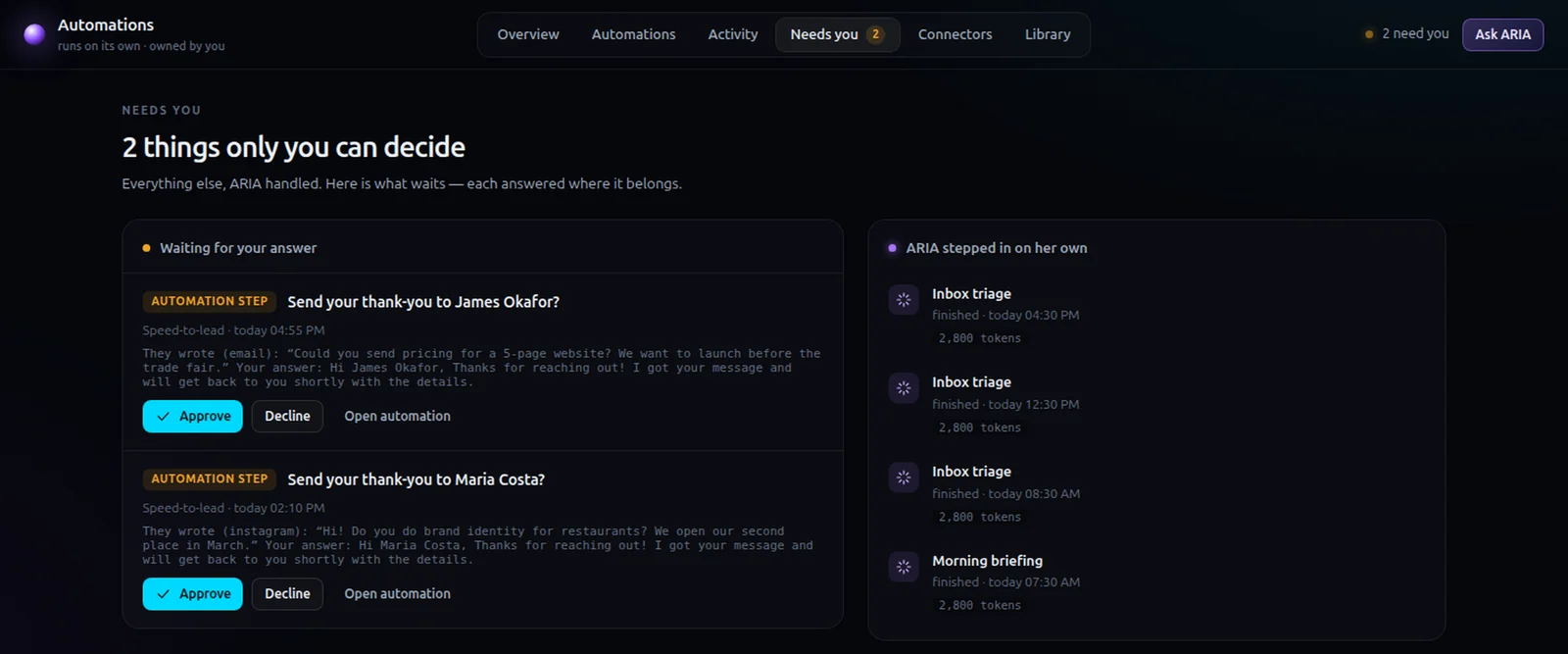
Steps waiting on your yes, questions from your chats, goal checkpoints, automations ARIA would like to start on her own initiative. They land in one place, and each is answered where it belongs. You see what the person wrote and the exact answer that would go out. Your yes counts for that one step and nothing else.

Needs you: two thank-you messages waiting for approval, each showing what the person wrote and the exact answer that would go out
Grant

Switching on is a contract.

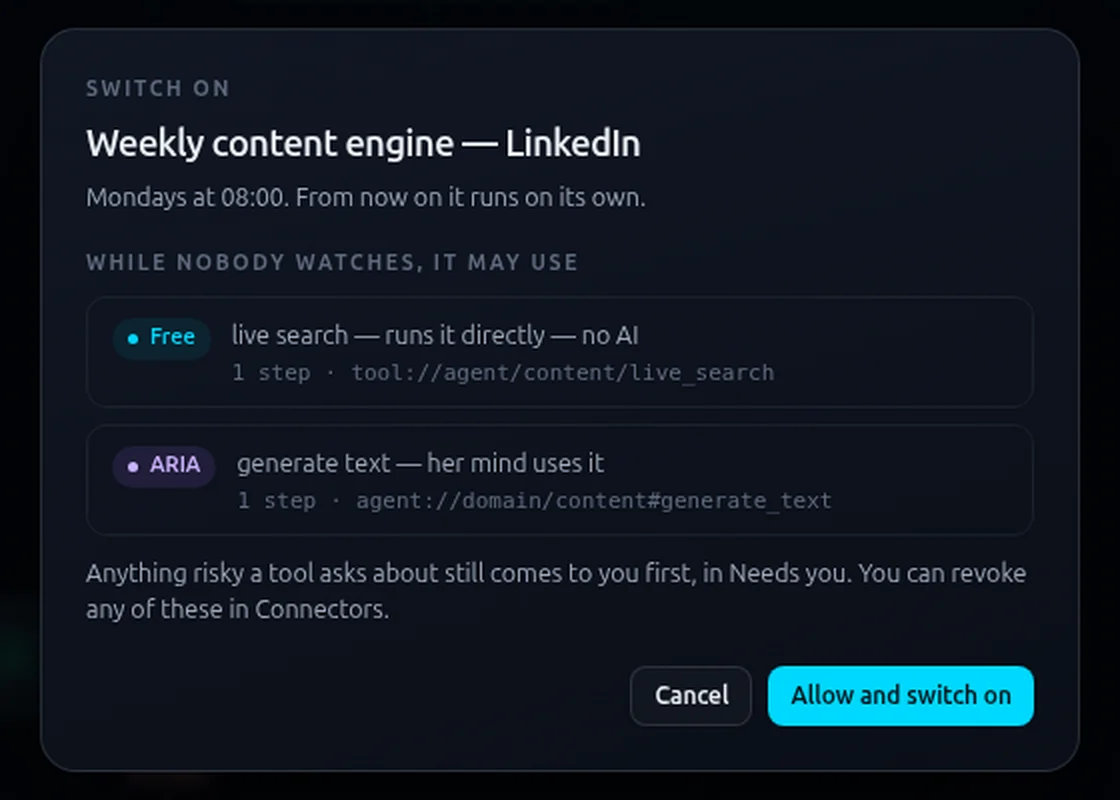
Before anything runs while nobody watches, you see every tool it will be allowed to use, free steps and mind steps apart. Your switch grants exactly those, and the granted steps then run without asking again. What only a human may answer, and anything her mind decides needs you, still comes to Needs you. Take any grant back in a tap.

The switch-on sheet: while nobody watches, this automation may use live search (free, no AI) and generate text (ARIA's mind), nothing else
Prove

Every run, every step, on record.

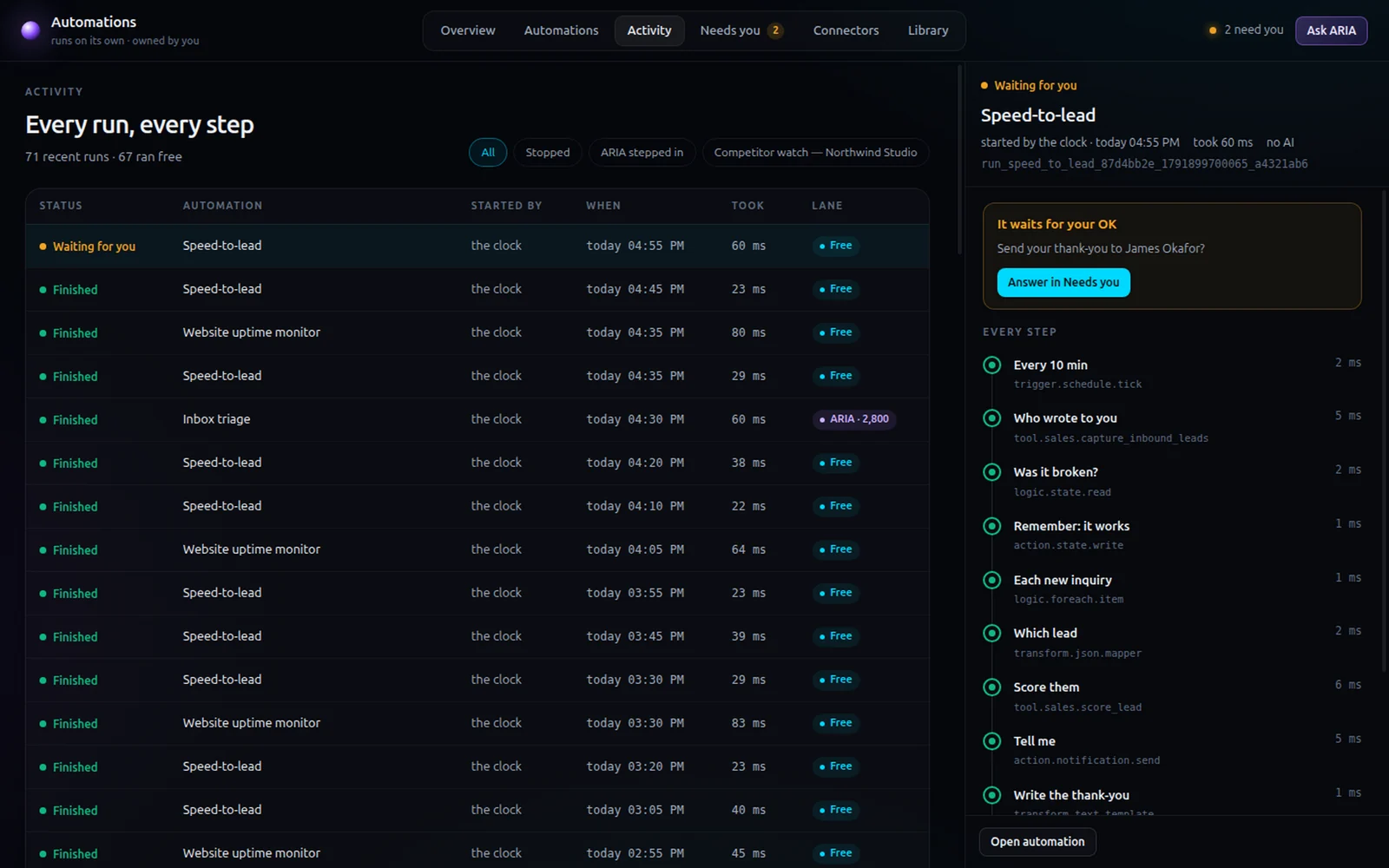
Who started it: the clock, you, ARIA, or a replay. How long each step took, in milliseconds. Whether her mind was used, and what it spent. And the sealed record of every run, its steps, its receipts, its ledger, kept in an encrypted database that opens only while ARIA is unlocked.

Activity: every run of the day, started by the clock, with the time each took, whether it ran free, and the sealed record of the selected run step by step
Start

Ready-made, when you'd rather not say it.

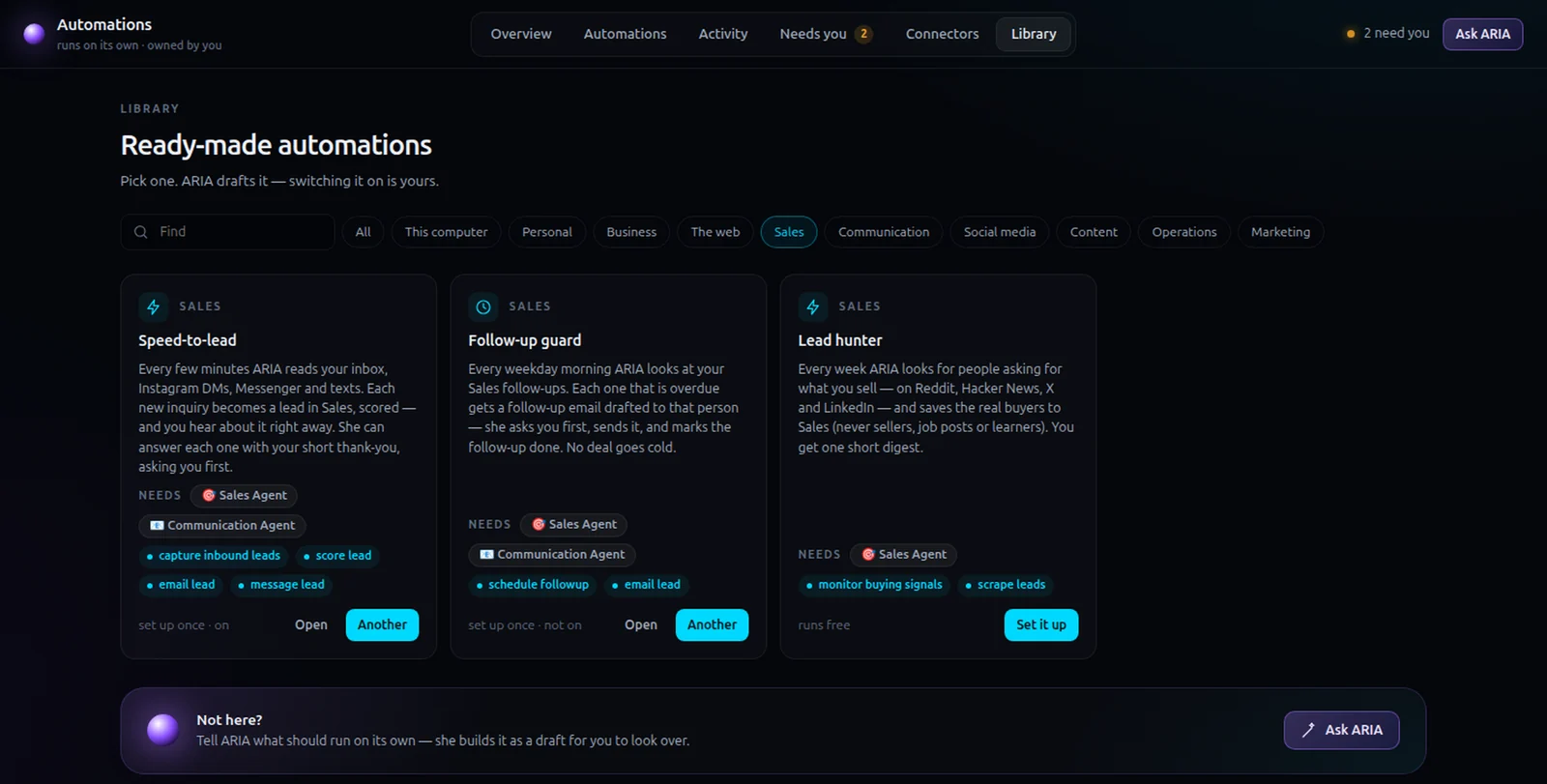
The agents bring their own: Speed-to-lead, Follow-up guard and Lead hunter from Sales, Inbox triage from Communication, Competitor watch from Marketing, the morning brief from Operations. And for you: the morning briefing, tomorrow's plan the night before, the week ahead, price and page watches, the weekly review. Pick one, answer a few questions, and it becomes a draft waiting for your switch.

The library's Sales automations: Speed-to-lead, Follow-up guard and Lead hunter, each listing the agents and tools it needs
Watch

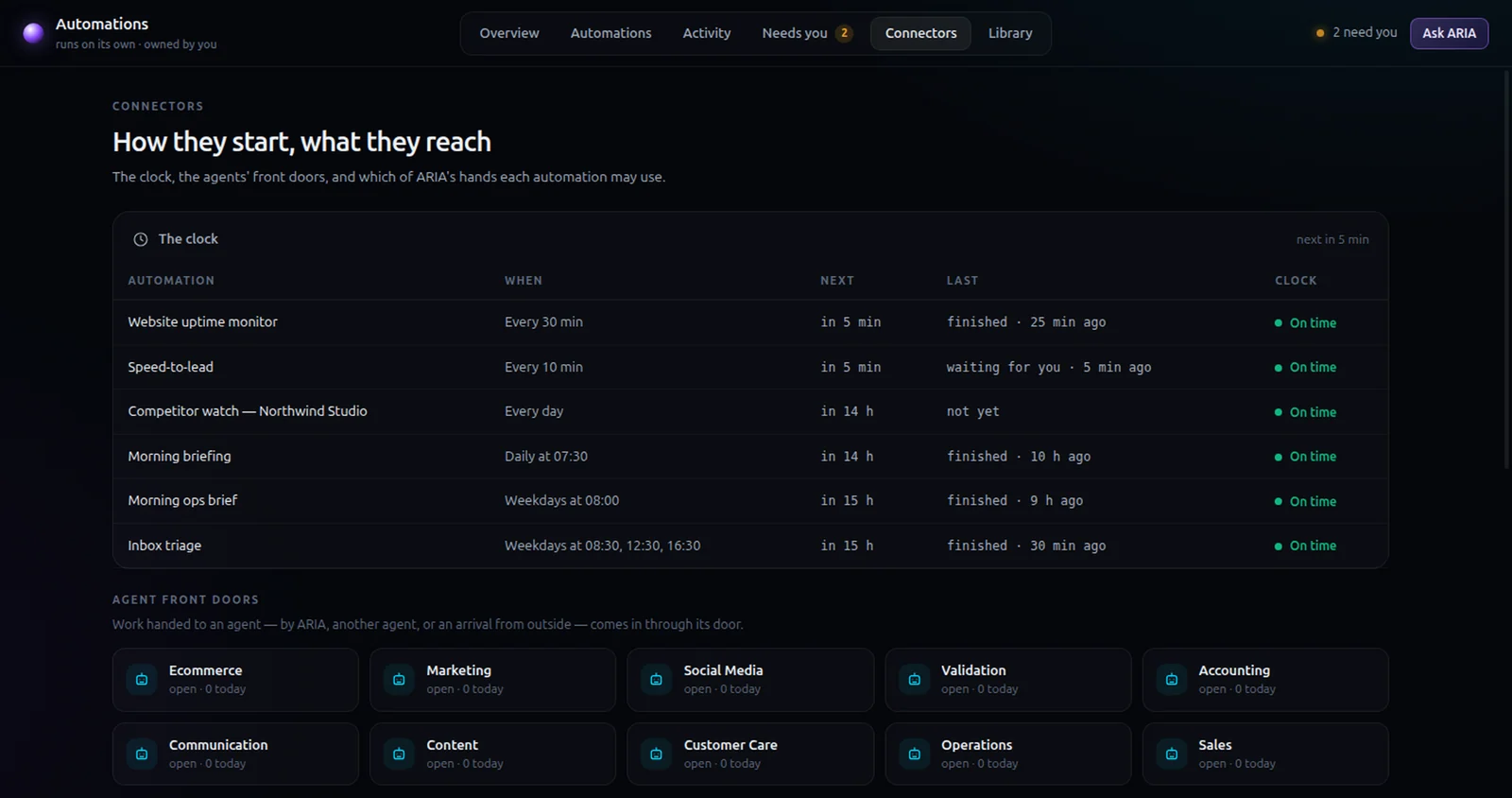
The clock, and every hand you granted.

When each automation runs next, how its last run ended, and whether the clock is on time. Below it, every hand you have granted, automation by automation, one tap from being taken back.

Connectors: the clock with each automation's schedule, next and last run, and the agents' front doors
The Forge
Connections she builds herself

Any service. Wired by ARIA. Sealed by you.

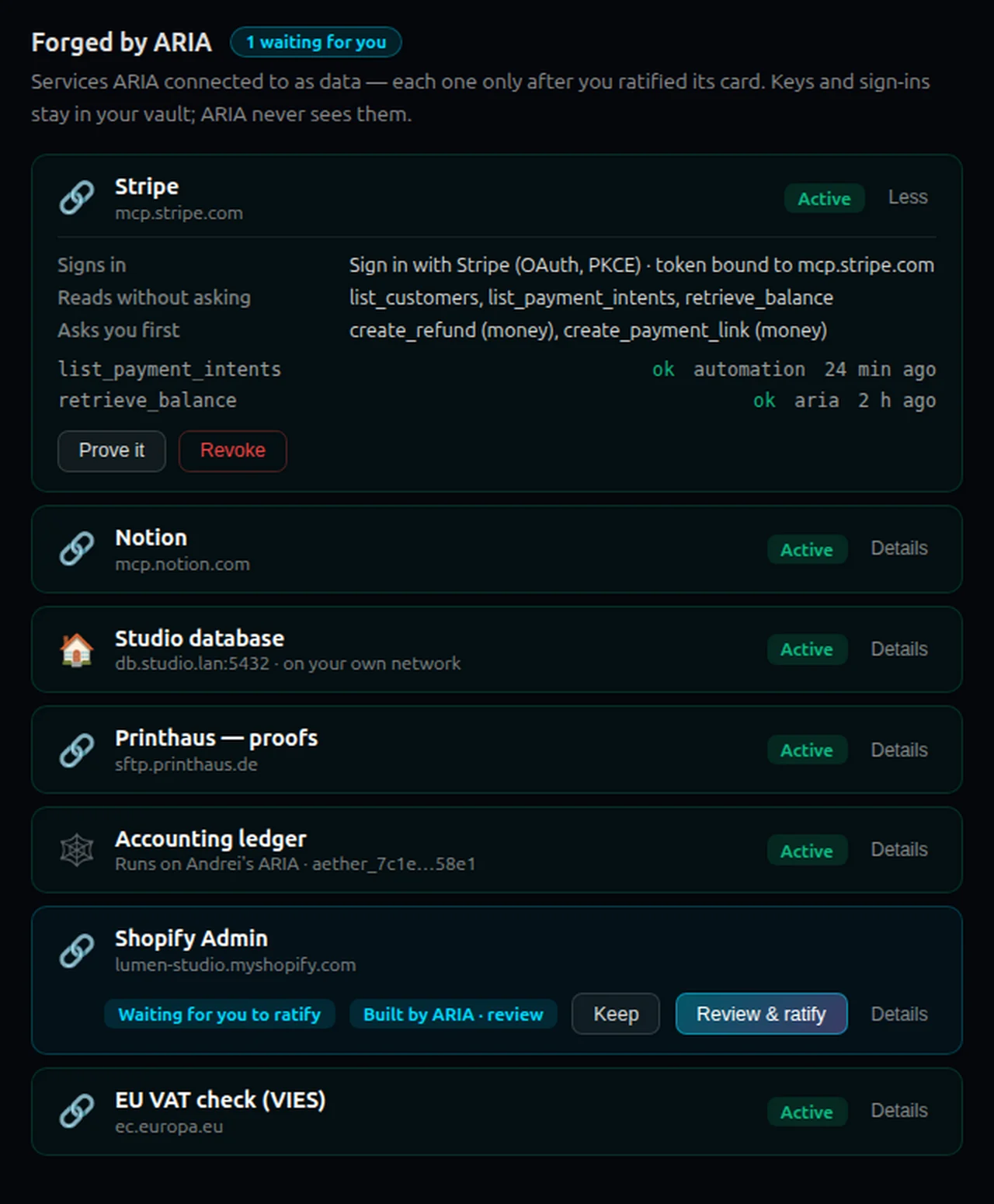
Every integration platform ends up maintaining thousands of hand-written connectors, and you wait for yours. ARIA doesn't wait. She reads the service's own description, an API spec, an MCP server, a WSDL, and forges the connection as data: hosts, paths, what each answer may show. Then she brings you its card: what it may read without asking, what must ask first. You ratify it. The key goes from your hands into the vault, and ARIA never sees it. Once ratified, the connection is a step on her canvas.

REST & OpenAPIOAuth 2.0 + PKCEMCP serversSOAP & WSDLSFTPEmail: send and readWebSocket & SSE streamsYour database, read-onlyAWS SigV4 · client certificatesDigest loginRomanian e-Factura (UBL)On your own networkOn a partner's ARIA
Data, not code

A connection is a sealed description, not a program she wrote. Only methods we ship ever run, so her wiring can't smuggle in code. Rows can be checked, diffed, revoked and shared. Code can't.

Your key, not her eyes

Keys and sign-ins go from you into the vault as bytes and come out only to be sent. Revoke a connection and nothing can call it again, by any path, instantly.

Shared, never copied

A connection can run on a partner's ARIA over AETHER. Yours asks, theirs answers, their key stays with them. Every write asks your yes. Money and legal acts never cross.

Settings, Forged by ARIA: Stripe, Notion, a studio database on the local network, a printer's SFTP server, an accounting ledger running on a partner's ARIA, a Shopify connection ARIA built waiting for you to ratify, and the EU VAT check
What wakes an automation

Eight things that wake her. And your hand, any time.

An automation starts when something happens, not only when the clock says so. You, ARIA, or another automation can also start one by hand.

◷
The clock
Every ten minutes, weekdays at 08:30, the first of the month. One clock, hers.
⤓
A file lands
Drop a file into a watched folder and the automation picks it up. One run per file.
✦
ARIA says so
An agent finishes, a goal completes, a reminder rings. Her own notices start work.
◎
A page opens
A page you or ARIA open in her browser. Private visits never count.
⧉
You copy something
Text you copy. Anything shaped like a secret is dropped before it's read.
▦
A new row
A new row in your database, read-only. The table itself is never copied.
≋
A live stream
A service's event stream through a forged connection. One run per event.
⌁
A local knock
A program on this machine calls the automation's own address, with its own secret.
Cloud automation. Self-hosted workflows. Or an operator?

Three ways to automate. One thinks.

Cloud automation is easy, and rented. Self-hosted workflow tools are yours, and hard. ARIA builds the operation, runs it on your machine, thinks inside it, and brings you only the decisions.

Cloud automation
Self-hosted workflows
ARIA Automations
Who builds it
You, block by block
You, node by node, plus expressions and code
ARIA, from your sentence
Where it runs
Their servers
A server you set up and maintain
Your machine, inside ARIA
Testing it
A test run does the real thing
Pinned sample data, or the real thing
A rehearsal runs every step and simulates every side effect
When it needs judgment
A bare model call
An AI node with tools you wire
ARIA herself, with her memory, her tools and her agents
A service it doesn't know
Wait for their integration
A community node, or code it yourself
She forges it from the service's own spec. You ratify
Money and legal steps
Run once it's switched on
Run once it's activated
Money only under your cap or with your yes. Legal acts ask every time
When it breaks
Retries, then a pause
Whatever error branch you built
You're told the first time. Five failures in a row and it stops, loudly
The bill
Per task, every month
Your server, your upkeep
No per-task bill. A model only where judgment is needed
Your keys
In their cloud
On your server, often inside the flow
In ARIA's vault, never inside a flow, never seen by her
The receipts

Four rules. Four numbers.

Each one is how the engine is built, not a setting someone remembered to switch on.

1
Yes per ask

A yes answers exactly the step that was waiting for it. A later run of the same automation can never reuse it.

0
Real actions in a rehearsal

A rehearsal runs every step on sample data. Sends, payments and writes are simulated. Nothing leaves, nothing is written.

5
Failures, then it stops

Told the first time. Five failures in a row and the automation stops itself, with a critical alert instead of a quiet log line.

59
Built-in step types

On top of those, every tool ARIA has, every agent's tool, every connection she forges, and ARIA herself, can be a step on the canvas.

What it costs

Software that stops billing you.

Automations run inside ARIA, on your machine, and nothing meters the runs, the steps or the tasks. Run one a thousand times and there is still no bill for it. When a step needs judgment it uses the model you chose, your own key or a model on your machine, and every run shows exactly what it spent. What comes included depends on your plan.

Already decided? Download ARIA →
The bottom line

Describe the operation. Own the operator.

For the business you run and the life around it. ARIA builds it from your words, runs it on your machine, thinks inside it where it counts, and brings you only the decisions that are yours. Owned, not rented.

Built from words · rehearsed before real · her mind inside · on record · owned
Frequently asked

The ten things people ask first

What are ARIA Automations?

Operations that run on their own, for your business and your life, inside ARIA, on your machine. You describe the outcome in a sentence and ARIA builds it as a flow of steps: what starts it, what it does, which of her tools, agents and connections it uses, and what happens when something fails. Her clock runs it from there, or a file, a row, a page or a copy wakes it. Plain steps run with no AI call. When a step needs judgment, ARIA herself runs it. Anything only you can decide waits for you in one place, called Needs you.

Is this just a set of ready-made automations?

No. The library is a shortcut, not the product. ARIA can build essentially any operation you can describe, from the clock, a file, a database row, a page, a copy or a live stream, through her own tools, her agents, any connection she has forged, and her own mind, to a notice, a document, a message or a write to a service. The ready-made automations from her agents are there for when you would rather pick than say it.

Is it only for business?

No. The same engine runs your personal life: a morning briefing from your calendar, a price you're waiting to drop, a page you keep checking, a weekly review saved as a document, your website or the NAS at home going down. Business and personal automations sit side by side in one ARIA, on your machine, and each one only touches what you granted it.

Do I have to build the flows by hand?

No. Tell ARIA what should run on its own, in the chat or in the Build it box of the Automations view. She drafts it, checks it, and rehearses it on sample data with every side effect simulated. Every step is visible on the canvas, and you change any of them by asking her in words. When you ask her in your own chat, she builds it and switches it on. When she proposes one on her own initiative, it stays a proposal in Needs you until you say yes.

Can ARIA actually think inside an automation?

Yes. A judgment step is ARIA herself: her mind, with what she remembers about your business, her tools and her agents, running inside the flow with a focused instruction. She reads and judges. If her mind decides something needs you, the run parks in Needs you with her own words, and your yes answers that one step. Every run records what her mind spent. Most steps never call a model at all.

Does every run cost AI tokens?

No. Most steps are plain work, like fetching a page, reading a file, comparing, remembering or notifying, and they run with no model call at all. A step that needs judgment uses the model you chose, your own key or a model on your machine, and the run records exactly what it spent. We don't bill per task, per step or per run.

What can an automation do without asking me?

Exactly what you granted when you switched it on: the tools it lists, and nothing more. Your switch is the standing approval, so those granted steps run without asking again. Money moves only under a spending cap you set for that connection, or with your yes naming the amount, and never on a background run. Legal acts ask every time. What only a human may answer, and anything her mind decides needs you, still parks in Needs you. In the ready-made automations, messages to other people ask first by default, and you can turn that off.

What happens when something breaks?

You hear about it the first time, in plain words, with the reason. The ready-made automations report a source that stops answering once, and once more when it is back. After five failures in a row an automation stops itself and sends a critical alert. If one wakes itself too often, the loop guard switches it off and tells you; nothing can ever switch one on by itself. If ARIA closes in the middle of a run, that run is marked interrupted when she starts again, never blindly run a second time.

Do automations run when ARIA is closed? Can a service reach one from the internet?

They run while ARIA runs. The engine lives inside her on your machine and sleeps while she is locked. When she is back, anything overdue runs once, so missed runs never pile up. An automation's own web address listens on this machine only: a program on the same computer can call it, the internet cannot. A public address for webhooks from outside is not live today.

Where do my data and keys live?

On your machine. Automations, their runs and their records live in an encrypted database that opens only while ARIA is unlocked. Keys and sign-ins live in ARIA's vault as bytes, never inside a flow, and ARIA never sees them. A step reaches the internet only over HTTPS to public addresses, unless you mark it as being on your own network. When a step uses a cloud model, only that request goes to the provider you picked; with a local model, nothing does.